
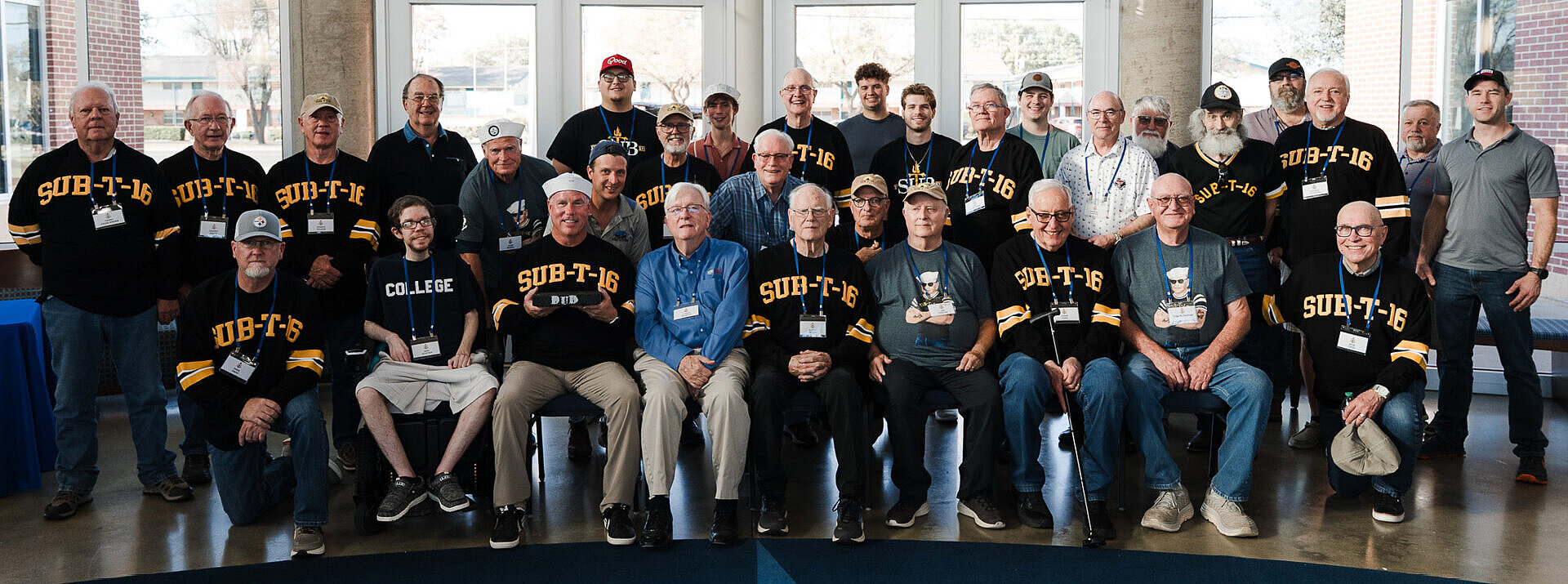
Sub T-16 Celebrates 60 Years of Brotherhood
On the weekend of October 3-5, alumni of Sub T-16 returned to Lubbock Christian University to celebrate the club’s 60th reunion, and the experience reflected everything Sub T has represented for six decades: brotherhood, humor, faith, and a shared understanding that some stories are best left untold.
What began as an idea among Bob Cass (’74), Bill Bundy (’78), and the late Reagan Fletcher (’72) grew into a full-scale reunion. Encouraged by their wives to “follow their dreams,” the group set out to bring generations of Subbers back to campus. Fletcher began organizing the weekend but passed away suddenly after a brief illness in July 2024. Cass and Bundy carried the plans forward, determined to honor both their friend and the legacy they shared.
Cass said the idea grew out of years of conversations about the impact Sub T had on their lives. “We kept talking about how much Sub T shaped who we became,” he said. “At some point, we realized it was time to bring everyone back together and celebrate what this brotherhood has meant for sixty years.”
The trio’s collaboration was not new. Cass and Bundy, along with Fletcher and their wives Brenda (McNair, ’73) and DeeDee (Johnson, ’77), had previously worked together on the statue of Dr. F.W. Mattox that now stands at the entrance of McDonald Moody Auditorium on campus. During a weekend visit to Fletcher’s property near Bonham, Texas, the group decided it was time to “get the band back together,” planting the seed for the 60th reunion.
The celebration began Friday evening with pizza in the Cardwell Welcome Center before moving to the Cactus Theater for a night of music and memory. Alumni and current members gathered beneath a marquee bearing Fletcher’s name. His estate provided tickets for the group to enjoy a show featuring hits from the 1970s and 1980s, and a placard from a play he directed while earning his graduate degree at New York University appeared among the theater’s “coming attractions.”
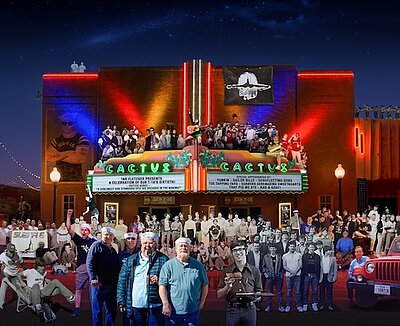
As part of the evening, organizers unveiled a digital “family photo,” a composite image featuring Subbers from across the decades. Cass said the image captured the continuity of the brotherhood. “Seeing everyone represented together like that reminded us that Sub T is bigger than any one era,” he said. “Each generation adds to it, but the heart of it stays the same.”
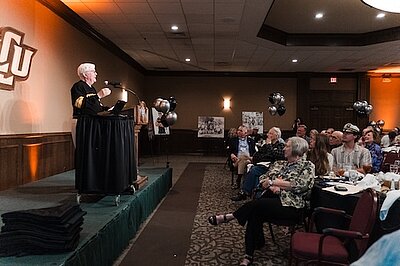
Saturday’s schedule leaned fully into tradition and camaraderie. After breakfast at Rudy’s, the group split between Golf Suites and Hub City Clays for an activity dubbed “Golf with a Gun.” The day concluded with a banquet at the Baker Conference Center on campus, where “Vintage Tars” entertained the crowd with Sub T stories, loosely based on real events and enthusiastically embellished.
For Bill Bundy, helping plan the reunion was about far more than logistics. “Helping plan Sub T’s 60th anniversary was a lot of fun,” he said. “One of the best parts for me over the last several years has been getting to know the current Subbers on campus. Spending time with them, swapping stories, and laughing together has reminded me just how special this group is, no matter the generation.”
Even for those unable to attend, the sense of brotherhood remains strong. Harrison Childre (’23), who was not able to be present for the reunion, reflected on Sub T’s lasting impact. “All my best Sub T stories and memories are, of course, highly confidential, and any Subber will remind you, ‘loose lips sink ships,’” he said. “What I can tell you is that Sub T was, undoubtedly, the best part of my time at LCU.”
For recent graduates like Dean Mushambangabo (’21), who served as Skipper during the 2020–2021 academic year, Sub T memories are rooted in everyday rhythms. “One of my favorite times of Sub T was when we had this culture of eating together in the cafeteria every single day,” he said. “Our table was the biggest, loudest, and most chaotic in the cafeteria, and several times the caf staff would separate our tables to calm the room. It never worked. Anybody and everyone was welcome to sit with us.”
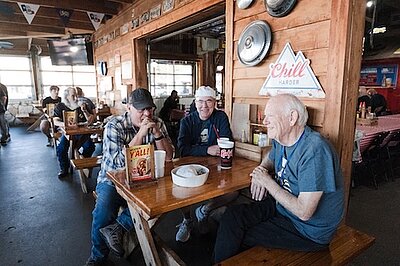
“That sense of belonging carried beyond mealtimes,” Mushambangabo said. “After lunch, we would all walk over to Starbucks, where we’d get drinks and proceed to hang out in the library right before everyone left for their afternoon classes. We were equally loud in the library, but the library staff loved us and would laugh along with our shenanigans. We did this every single day, every week. It made for some really funny moments but also fostered a strong sense of community among the Subbers.”
That humor, often self-directed, has always been part of Sub T identity. Michael Burkham (’81), who served as Skipper from 1977 to 1978, recalled the club’s reputation with tongue firmly in cheek, referencing Dick Laird, who served as LCU’s Dean of Students. “I thought it was a true brotherhood of rebellion until I realized that someone in Sub T was one of Dick Laird’s informants,” he said. “To be that kind of traitor has to be hard to live with for all of these years.”
Subbers are legendary for their Master Follies performances, a tradition that stretches from the club’s earliest years to today. During the banquet, Lamar Reinsch (’67) reflected on Sub T’s first appearances in Master Follies, sharing that in the club’s earliest skits he impersonated Dr. F.W. Mattox, first in a dark suit with a pasted-on mustache, frequently repeating the word “great.” The following year, the performance escalated with Reinsch portraying Mattox again, this time as “Uncle Billy” in the storyline of Cinderfella. From the beginning, Sub T performances were designed to get the biggest laugh in the room.
That legacy continues generations later. Cody Chumbley (’05), who served as Skipper from 2003 to 2004, said Master Follies remains central to Sub T identity. “My favorite memory has to be our ‘prep’ for Master Follies as Truckers and then Sweating to the 80’s,” he said. “Subbers will always be The People’s Choice.”
During the banquet, Reinsch also shared recollections of Sub T-16’s founding at Lubbock Christian College in 1965. He described the night prospective students rotated through tables in the cafeteria to hear from each social club, except one table that stood apart.
“The guy sitting there, Mr. Jim Ravanelli (’60), was only a few years older than the students and was working for LCC,” Reinsch said. “He told us that the school needed to have an additional club for men, that the decision had been made to add a chapter of Sub T-16, and that he would be the club sponsor.”
Reinsch, who served as Sub T’s first Skipper, later recalled explaining the newly formed club to his father, a World War II submariner. “His first comment was, ‘but those titles are for officers in the Merchant Marine, not a submarine,’” Reinsch said. According to club lore, the Tuscarora did not begin as a submarine but submerged early in its history, possibly to avoid the attention of university administrators.
Another long-whispered legend within Sub T began quietly in the early 1990s and was not publicly acknowledged until decades later. The story centered on Dr. F.W. Mattox, Lubbock Christian University’s founding president who served from 1957 to 1974, and a surprising connection to the Sub T brotherhood during his student days at Harding University.
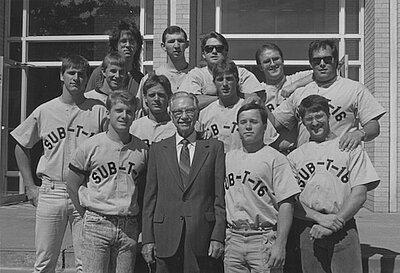
During his presidency, Mattox never indicated any affiliation with Sub T. Subbers were known for their spirited camaraderie, and university personnel did not always find it enduring. As a result, members were careful to stay off the president’s radar altogether, often believing that avoiding eye contact was the safest course of action.
The story first surfaced quietly when Mattox returned to campus in the early 1990s to speak in chapel. Skipper Ken Garner (’91) decided the club needed a picture with the former president. During the course of having the photo taken, Mattox casually mentioned that he had been a member of Sub T while attending Harding University. Subbers had no idea they were standing beside one of their own.
The revelation was met with equal parts disbelief and amusement. Unsure whether to take him at his word, the story circulated quietly within the brotherhood for years, becoming part of Sub T lore rather than public knowledge.
That long whispered story was finally acknowledged publicly during the unveiling and dedication of Mattox’s statue at Homecoming 2020. Though Mattox had been deceased for many years by that time, the dedication confirmed what Subbers had quietly carried for decades, solidifying a connection between the university’s earliest leadership and one of its most enduring student organizations.
The banquet also included the formal induction of David Fraze (’91), who served as emcee for the evening despite having been a member of the men’s social club Tomo Dachi during his college years. After pledging for a week like every Gob before him, Fraze officially joined Sub T-16.
The weekend concluded Sunday morning with worship in the Cardwell Welcome Center before final goodbyes were exchanged. As alumni departed, one thing was clear. Sixty years after its founding, the brotherhood of Sub T-16 continues to thrive, grounded in faith, strengthened by laughter, and sustained by the stories, both shared and safeguarded, that bind Subbers together.
Reunion Committee
In the official banquet program, the Sub T-16 60th Reunion Committee offered thanks to the university staff who helped facilitate the weekend. It also felt important to formally recognize “every Dean of Students, sponsor, and university administrator who cut us some slack.” The following Subbers served on the reunion committee and helped make the weekend possible.
Gary Adams (‘72)
Bill Bundy (’78)
Bob Cass (’74)
Terry Cartwright (‘78)
Cody Chumbley (’05)
Eddie Fitzgerald (‘75)
Howard Karbo (‘72)
John King (’68)
Dennis Maupin (‘75)
Dean Mushambanjabo (’21)
First Skipper Lamar Reinsch (’67)