
Faith in the Middle of Grief: A Professor’s Journey Through Loss
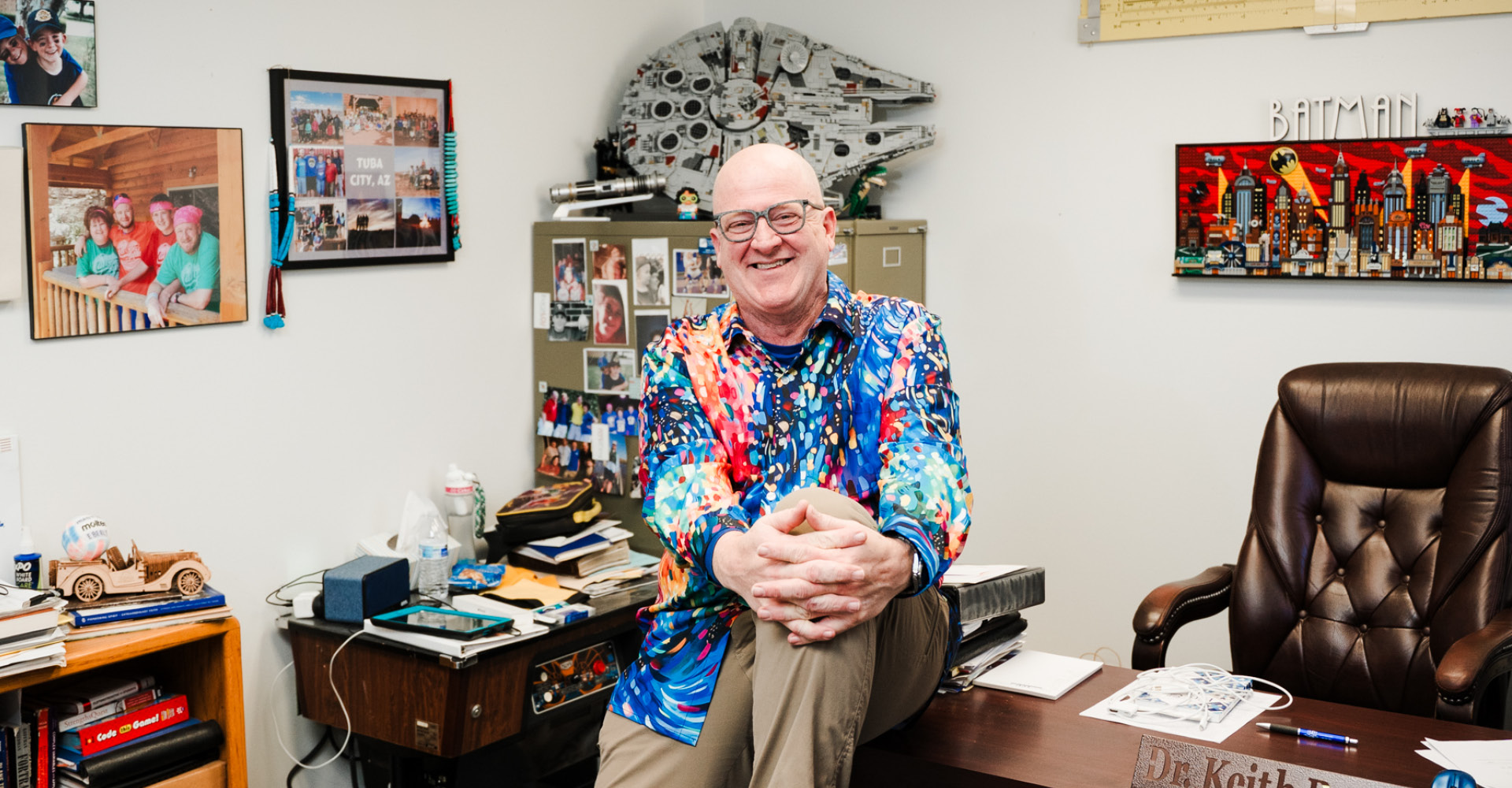
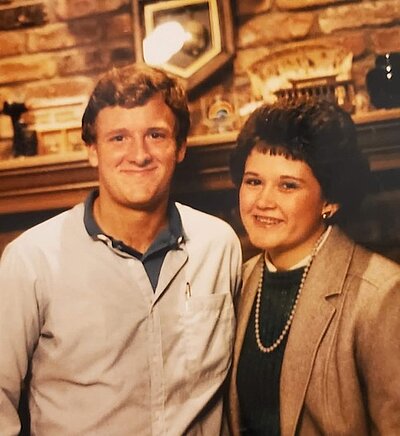
“‘Keith-and-Kelly’ was one word,” recalled Dr. Keith Rogers (’89), Chair of Lubbock Christian University’s Department of Mathematics, reflecting on his relationship with his late wife, Kelly (Price, ’87). “She and I took the two-become-one verse (Gen 2:24) seriously,” he explained. “Over the last few years, it has been difficult to use singular adjectives, like ‘my house,’ or ‘my children.’ It was always ‘our,’ ‘us,’ or ‘we.’”
Rogers doesn’t recall his parents ever saying it out loud, but the lives they lived impressed on him the importance of family from a young age. “Your family is more important than your job,” he recalled. “‘You can get a new job, but you can’t get a new family.’ Growing up, I don’t think there was ever an event that at least one of my parents didn’t attend.”
Dr. Rogers has brought this philosophy of life into his classroom, hoping to impress on his students just how important it is to prioritize family. “If I need to give a walk in a class, I tell my students why,” he explained. “It is normally due to a family event or procedure. Even if they don’t learn any math in my class, they should learn that cornerstone, ‘Your family is more important than your job.”
Anyone who has ever been in one of Dr. Rogers’ courses knows that rarely does a day pass where he neglects to talk about God or his family, even from the very first day a class meets.
“I always confess that I am terrible with names with a story I’ve told for 35 years—that’s 70 semesters, more than 483 classes, and more than 6,003 students,” he added, adding, “God knit me together to be a numbers guy.”
Rogers recounted the story of how he met his wife—how he met two girls between his freshman and sophomore years of high school, and one was named Tammy, and the other was named Kelly.
“I was really attracted to Kelly,” he recalled, “but I got the names reversed. I would go up to her and say ‘Hey, Tammy.’ She would respond, ‘My name is Kelly, not Tammy—it has never been Tammy.’ I did this for five straight days,” he admitted. “She ended up making me wait one year for each day that I called her Tammy before she agreed to marry me.”
The Rogers’ family cornerstone about the importance of family has never felt more poignant than it has the past three years since Kelly’s death, but the lesson is one he’s felt throughout his teaching career.
Kelly was first diagnosed with breast cancer in January 2013. “We had lots of doctors’ appointments and procedures during that semester,” Rogers recalled, “so I was missing class a lot. Kelly was adamant that we didn’t talk about it because our oldest son was in his last semester of high school, and she did not want the spotlight to not be on him. When we got to Spring Break, however, we started telling people. I felt relief,” he recalled, “because I could finally tell my students why we were not having class. One of those classes gave us some flowers and a card after a procedure—it was unexpected, and deeply moving.”
Still, Kelly’s cancer remained manageable, and it wasn’t until nearly a decade later, in September of 2022, that things changed.
“On September 20, 2022, at 1:28 a.m., we got the liver cancer diagnosis,” Rogers recalled. “We told people right away—no need to worry about the spotlight this time. One of my classes got us a Braum’s gift card,” he shared. “I was blown away that these college students with limited financial resources had taken up money to bless us—it was the first time I wept in class. I told them that their parents would be very proud of their selflessness, and I also told them that when their parents were on campus, that they must bring them to me, so that I could brag on them.”
LCU did not begin using the brand promise, “We Walk with You” until Fall 2023, but Rogers explained that he felt that spirit at LCU even then in 2022. “As an institution, we mean that we employees walk with our students,” he explained. “These are two examples where, instead, it was our students walking with the employees.’”
Even with such support, however, Rogers recalled that the fall semester of 2022 was difficult.
“I refer to it is as ‘Diagnosis Semester,’” he explained. “Kelly and I promised each other that we would do our best to have ‘normal’ lives. Let me tell you, ‘normal life’ and ‘cancer life’ are exhausting.”
However, even through the seemingly endless rounds of chemotherapy and doctor’s visits as both he and Kelly pushed through their jobs, Rogers recalls the unfailing support of the “cloud of witnesses” who surrounded him, Kelly, and their family throughout the illness.
“We had lots of people love on us. We were given loads of gift cards—chemo took away Kelly’s normal palate for food, so we would never know what sounded good to her until it came time to eat. I could brag on our children and their cloud of witnesses here,” he added. “People were loving on them just as much as they were loving on us. My colleagues in the math department took over tasks that I as chair needed to do. There is one faculty member in particular who stood out during this semester, who wasn’t even in my department, but he started just giving me these huge bear hugs,” he recalled. “Sometimes it was just the hug, and sometimes it included conversation. He is still giving me these hugs closing in on three years later—just being present.”
According to Rogers, that kind of presence is one of the most profound things anyone can do for someone who is grieving. He recalled that his father, Richard, lost his own father, Keith’s grandfather Byron, or “Buck,” when Richard was just 14 years old. While his father never spoke much about the impact that Buck’s death had on him, Keith does recall one story in particular about a friend who, soon after the death, walked into his house and told him that Richard needed to get out of the house. The two of them walked around the neighborhood.
“I don’t remember if dad ever said how long or how far they walked,” he said. “They just walked, with no words. Dad said this was the best thing anyone did for him during that time. Being present and just ‘walking with you’ are huge things you can do for someone going through grief and trauma,” he emphasized. “You may not know what to say—you probably don’t need to say anything. Just be with people.”
During “Diagnosis Semester,” Rogers recalled that he had full hope that God would heal Kelly.
“I knew that the chemo was working—until Kelly’s body failed. Her platelet count dropped really low and she could no longer get chemo,” he recalled. “This is when the cancer ‘exploded in her liver’—a direct quote from the doctor. When I heard that, I laughed out loud, and all the medical professionals in the room looked at me like I had lost my mind,” he recounted. “I told the doctor, ‘Thank you for using a “normal” word. You could have used some medical term, but instead you used a word that everyone understands.’”
Keith, Kelly, and their family received this news on Thursday. The next day—January 27, 2023, at 4:48 p.m., as Dr. Rogers recalled in his true numbers-guy fashion—Kelly’s body succumbed to the cancer, and she went to meet Jesus.
“‘Death Semester’ (Spring 2023) was obviously different,” Rogers shared. “Kelly had made me and our kids promise (actually make a covenant) that we would do our best to do life as normal as possible. We went to an event Saturday morning, I went to church on Sunday morning, and I went to chapel on Monday. People would ask us, ‘Why are you here?’ or ‘How are you here?’ My response was that I had made a covenant with Kelly. I would also say, ‘I woke up on Sunday morning—I am supposed to be with my church family,’ and ‘It is Monday at 11 a.m.—I am supposed to be in chapel,’ and added, ‘Besides, lying in my bed in the fetal position is not helping anyone at all.’”
Rogers has always liked the book of Job, largely because his father also liked it, but also because of the part where God compliments Job to Satan. “God knows that Job will be strong through the trauma and difficulties that Satan will throw his way,” he explained. “We had our share of ‘compliments’ in our marriage, but little did I know what losing your spouse was going to be like. Sometimes, I am tempted to say that God has forsaken me, but I know that he has always been with me in every high and low that I’ve experienced. Kelly and I would ask each other, ‘How do people who don’t have God in their lives survive?’ We have such a great cloud of witnesses that we could not fathom surviving without them.”
Even so, Dr. Rogers says that his teaching and relationships with students haven’t really changed much since Kelly’s death, but there are exceptions.
“Now, when I use an example of my family, I have to pause to collect myself,” he shared. “Or, when I roll the dry erase marker in between my hands and it doesn’t click with my wedding ring—” he explained that during chemotherapy, he and Kelly had to exchange their original metal wedding bands for silicone ones, since her hands shrunk from the procedure, “—that is hard. So, I try to not roll the marker—but a thirty-year habit is hard to break.”
Keith shared that he is not ashamed to cry in front of others, and in fact he hopes that if and when students see him being emotional about missing Kelly, they get an authentic picture of what a grieving, faithful life can look like.
Rogers shared that there were countless scriptures that carried him through different parts of this journey, but two that stand out today are 2 Corinthians 1:3-4: "Praise be to the God and Father of our Lord Jesus Christ, the Father of compassion and the God of all comfort, who comforts us in all our troubles, so that we can comfort those in any trouble with the comfort we ourselves receive from God;” and Acts 20:35b: “…remembering the words the Lord Jesus himself said: ‘It is more blessed to give than to receive.’”
“I feel like I have done more ministry since January 27 than I did in all my time before that,” Rogers emphasized. “There have been people who have been put on this widow/widower path since I have, and I do my best to comfort them. I have been told that I am inspiring, and that people admire my strength—people are watching me as I continue to survive. They sincerely ask me how I am. There is a gang of girls at church that still give me hugs every Sunday, and I know they do it in honor of Kelly. According to parents, lots of kids are still praying for me by name—that is both encouraging and humbling.”
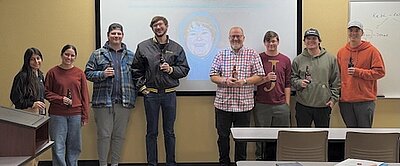
One particularly profound opportunity to share his and Kelly’s story started from a casual conversation with Dr. Shannon Rains, Chair of LCU’s Alfred & Patricia Smith College of Biblical Studies and Professor of Children’s Ministry.
“Shannon and I were helping freshmen move into Johnson Hall,” Rogers explained, “and she truly asked me how I was doing. I told her the truth: that I was impatient, hopeful, frustrated, blessed, struggling, covered in prayer, hollow, surrounded, touch-starving, grateful, lonely, and loved. This is when she asked me if I was willing to be a guest speaker in one her ministry classes. She has students who are training to be ministers, and she wanted them to see, feel, and be exposed to real grief.”
Keith agreed, and together they planned the class. Dr. Rains envisioned Dr. Rogers’ entrance to be as genuine of a simulation as possible of a member of the church coming to speak with a minister.
“She did not tell them that I was coming,” he explained, “and she did not tell them what was going to happen during this class. I prepared a history of Keith-and-Kelly and then walked them through my journey so far. I gave them my insights into grief and gave them some practical tips to help them in their future ministries, like things that help me or bring me comfort.”
The class ended with “celebration root beers”—a Keith-and-Kelly tradition—and Rogers shared that it had been 1,008 days since Kelly enjoyed her final celebration when Jesus welcomed her home.
Dr. Rains shared, “I imagine it will be a lesson these students never forget.”
“Besides colleagues walking with me—and I could name a lot—there have been several students who intentionally have walked with me,” Rogers shared. “One student in particular who knew Kelly from church came into my office one day. I thought we were going to talk about calculus, because she was taking that class from me. Then, this student, who was engaged to be married, sat down and simply asked me, ‘What is your favorite memory of Kelly?’ I was shocked. My eyes filled up with tears. I sat there for an uncomfortable amount of time trying to answer. I finally fumbled out, ‘Every single one of them—that’s the truth. When you have been a couple with your best friend for nearly 40 years, and husband and wife for 35 years, 1 month, and 17 days, every moment is my favorite. I am truly a blessed man.’”